

Designing an Advanced UX Course
Role:
UX Researcher, UX Designer
Tools:
FigJam & Figma
Methods:
1-on-1 User Interviews, Affinity Mapping, Primary/Secondary Research, Journey Mapping, Ideation, Team Collaboration
Timeline:
8 Weeks
January 2026 - March 2026
Course:
Advanced UX Design
Overview and Context
During my final semester, I took an advanced UX course that presented a unique challenge. The UX program was still in its early stages, with only five UX majors in a class of thirty; the remaining students were majoring in Simulation and Game Design (SGD). This created a disconnect in how the course could effectively serve both groups.
This case study focuses on reimagining the latter half of the course to better align with UX principles and to create space for SGD students to leverage their strengths. As a class, we collaborated to design a solution that balanced both disciplines, ensuring that UX students could deepen their design process while SGD students could meaningfully apply their skills. Throughout the project, our professor acted as the project manager, guiding us through a structured, real-world collaboration.
Click here to view the entire design process on FigJam and created deliverables
Problem
The course lacked alignment between its structure and the needs of its students.
UX students needed deeper exposure to research, systems thinking, and iterative design processes.
SGD students excelled in execution, prototyping, and technical implementation, but lacked structured UX integration.
The original curriculum treated both groups similarly, resulting in missed opportunities for specialization and collaboration
Primary Research & Secondary Research (click here to view FigJam file)
Students in each major were required to interview students from the other major to gain mutual insight, then synthesize the key findings.
Primary Research Goals:
What are the professional goals of SGD majors taking the IDX-420 class and what do they want to get out of the course?
What career’s do SGD major’s intend to pursue?
What skill sets or software experience do SGD majors currently posses?
What kind of assignments do SGD majors find interesting and engaging?
What do kind of support do SGD majors need from this cross-disciplinary course in order to accomplish their goals?
Primary Research Methodology:
Two sets of 1-on-1 user interviews
Two sets of focus group interviews (interviewing four members at a time)
Synthesized findings, affinity mapping, and notes all in FigJam
Primary Research Affinity Mapping Overview
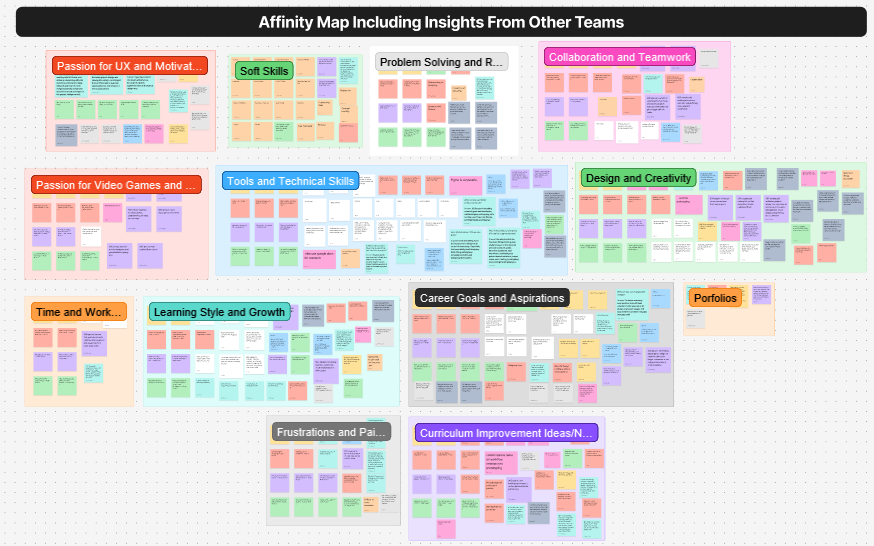
After synthesizing my findings and reviewing ungrouped insights from others, I affinity mapped everything into 13 distinct groups of pain points and observations.
Affinity Map Clusters:
Passion for UX and Motivations
Passion for Video Games and Motivations
Soft Skills
Problem Solving and Research
Collaboration and Teamwork
Tools and Technical Skills
Design and Creativity
Time and Workload
Learning Style and Growth
Career Goals and Aspirations
Portfolios
Frustrations and Pain Points
Curriculum Improvement Ideas/Needs
Needs (click here to view FigJam file)
Needs were developed collaboratively in a shared FigJam file and prioritized based on popularity and number of votes received.
Needs were initially categorized by:
Unmet needs
Ongoing/developing needs
Met Needs
Six Thinking Hats Decision Making Method
Each group member contributed multiple ideas during each six‑minute round, cycling through every hat.
Notes were taken on paper and documented in FigJam.
A few solutions/ideas discussed within my team:
Split the class into two separate 2-credit sections
UX students collaborate with SGD students to create a UX case study with a final product developed in Unreal/Unity Engine
Develop little assignments with a design process for game designers
Secondary Research
Students in each major conducted secondary research on the career and skill requirements of the other major and distilled key insights.
We then exchanged findings and individually constructed comprehensive affinity maps of those secondary research insights to validate and support their primary research.
Individual Secondary Research:
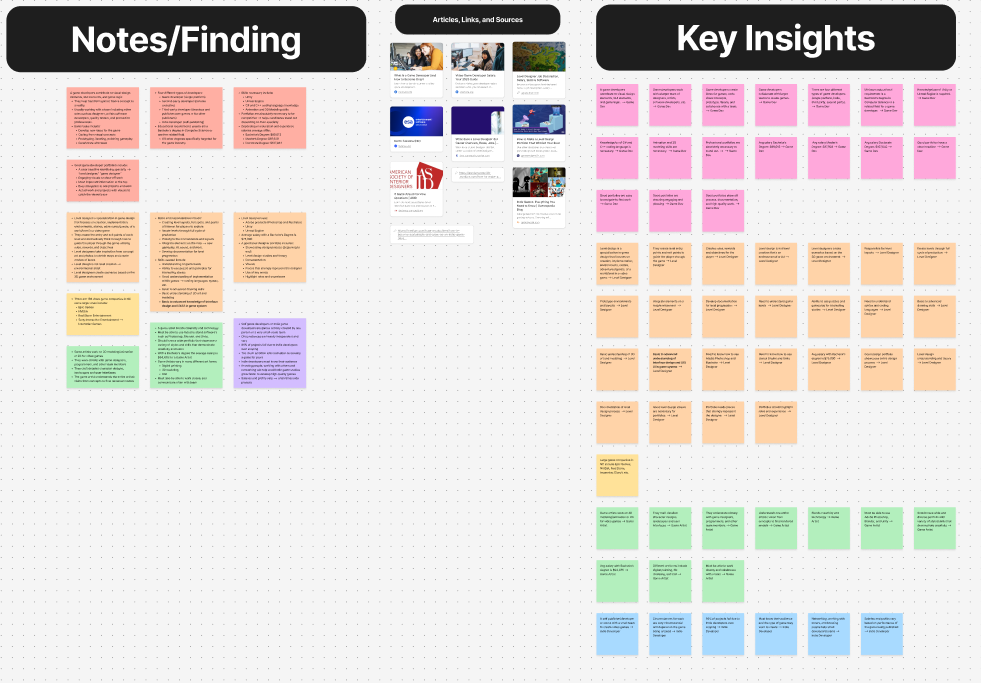
Ten published reports, articles, and trusted sources on Game Developer positions, salaries, responsibilities, careers, and more.
Notes taken in FigJam with 59 key insights generated.
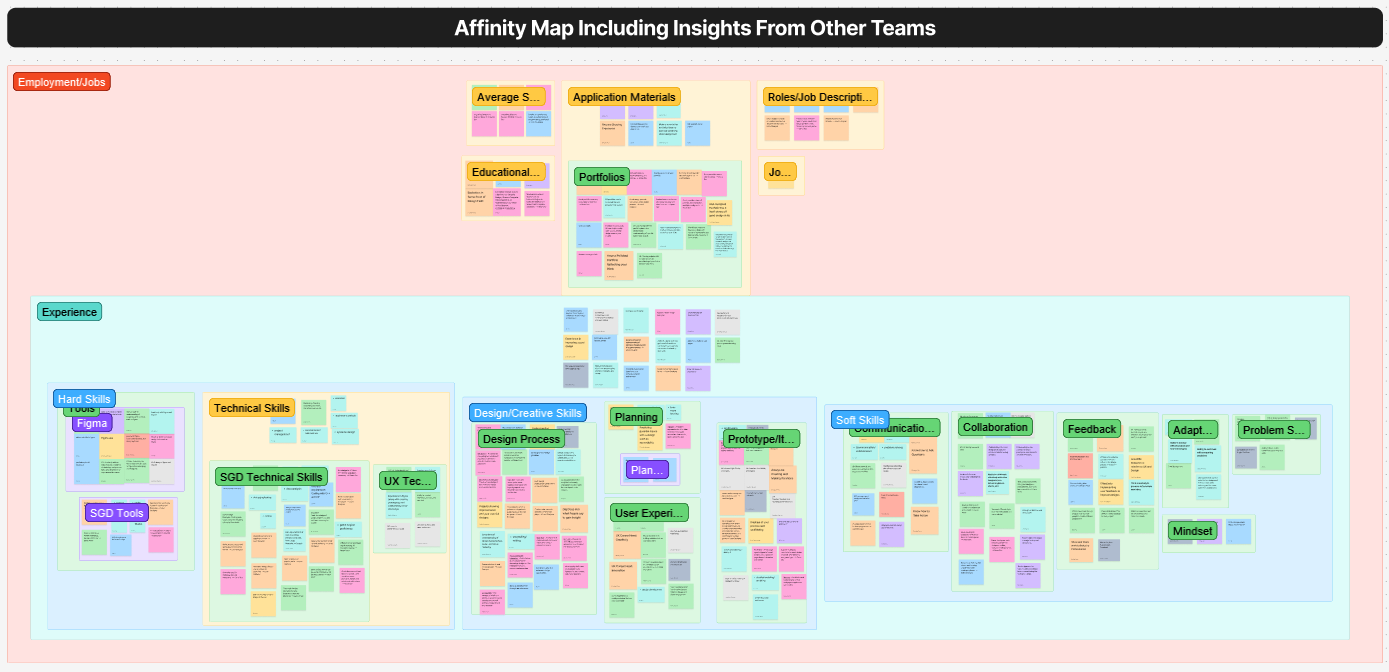
Secondary Research Affinity Mapping w/ Key Insights From Other Teams:
All key insights were synthesized and affinitized into 28 clusters.
Insights for skills, needs, tools, salaries, and other necessary materials for multiple professional pathways within UX and SGD.
Unmet and ongoing/developing needs were further grouped and then affinity-clustered based on votes received and popularity.
A few popular needs included:
Students need to apply typography, color theory, and visual hierarchy in practice
Students need to build compelling portfolio pieces
Students need to know design best practices and industry expectations
Students need to design accessible UI layouts
Ideation (click here to view FigJam file)
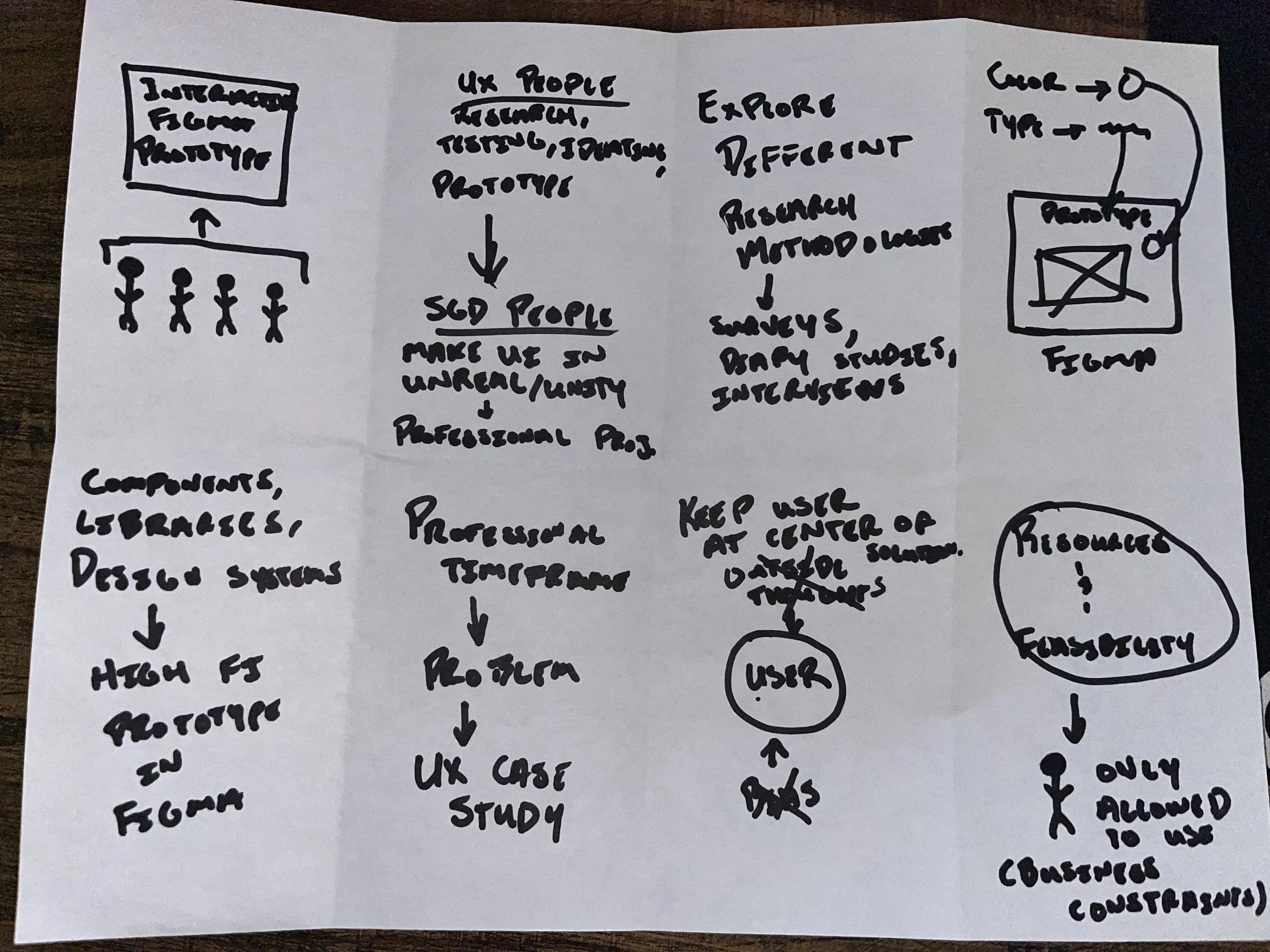
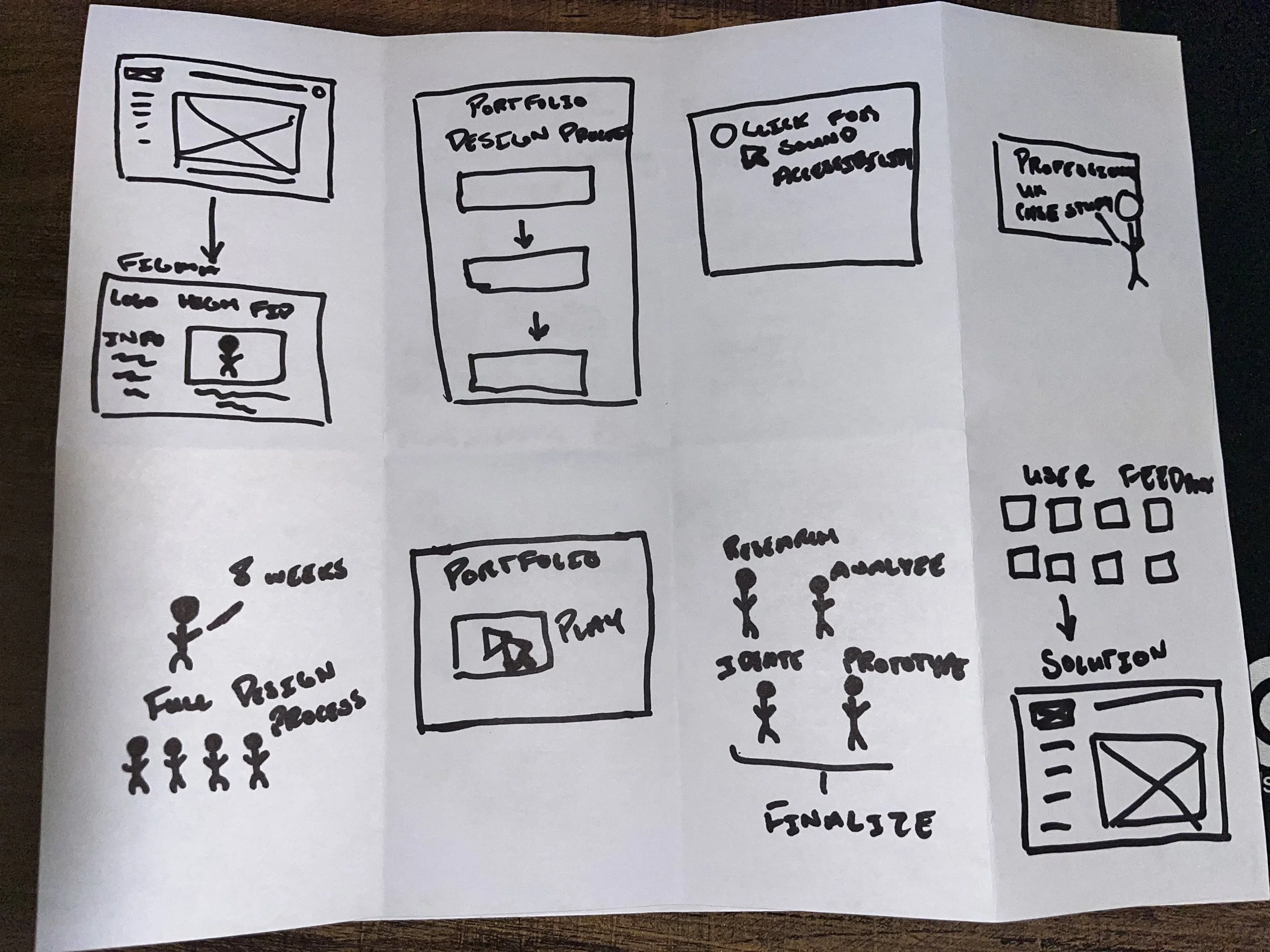
Considering both high-priority and less-popular needs, I applied the Crazy 8s design sprint to generate a range of solution concepts rapidly.
Here are some sketches from those sessions:
Impact/Feasibility Mapping
We collaborated to workshop ideas, plotted them on an impact–feasibility map, and selected one to design a solution for utilizing a user journey map.
The final solution selected by our team was:
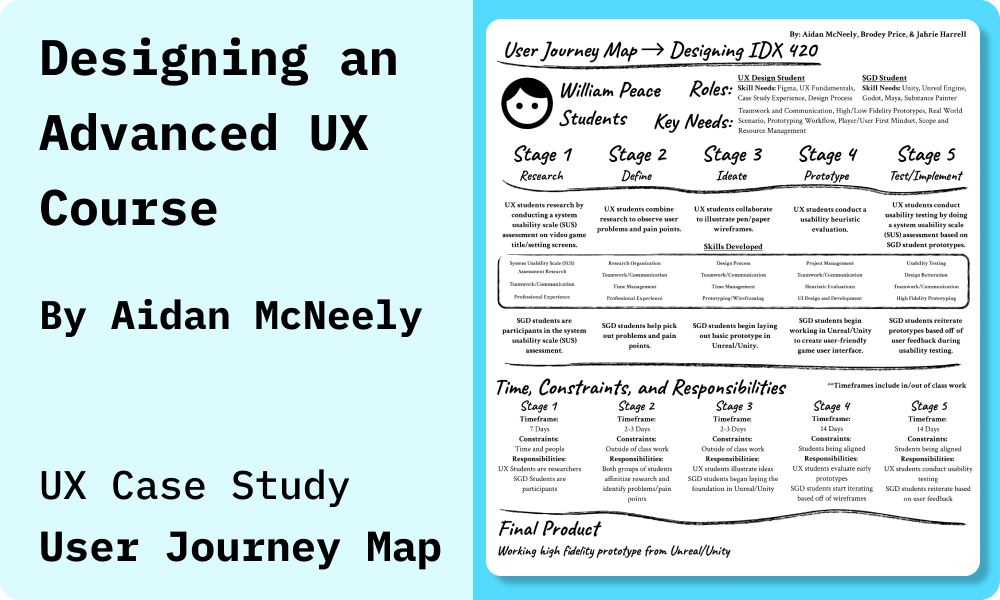
UX students collaborate with SGD students to create a UX case study with a final product developed in Unreal/Unity Engine
Final Solution
My team and I created a user journey map showing how UX and SGD students collaborate to produce a complete UX case study. The map outlines the full design process to simulate real-world collaboration and handoffs between game developers and hands-on UX professionals.
A few key deliverables would include:
System usability scale (SUS) assessment paired with observational usability testing
Primary/Secondary Research
Figma low and high fidelity prototyping
Unreal/Unity Engine working high fidelity prototype
User Journey Map
Presentation
Each team was required to present to the class and come prepared with notes or insights for a discussion-based focus group.
During these sessions, the class collectively evaluated the proposed solutions while the professor gathered feedback and determined the direction to move forward.
Impact
For the final eight weeks of the course, our professor adopted our proposed structure, adjusting deliverables and refining the overall process based on our recommendations. Ultimately, our team’s solution proved to be the most influential, shaping the direction of the class’s final project and case study.
Our classmates also recognized its effectiveness, noting that it successfully balanced the needs of both UX and SGD students by leveraging each group’s strengths in a cohesive, collaborative way.